|
Talks with Tyler Smith |
|
Talks with Tyler Smith |
|
Tyler Smith aka
Imbue
|
TS: The definition of Imbue is “inspire or permeate with a
feeling or quality” so I feel that pretty much speaks for itself and sums up
what I was aiming for with this album. I hope for every listener it will indeed
do just that. AV: As writer/producer of all the tracks on this project do
you enjoy being able to control your music through the entire process of
recording it? Is it easier or harder to do than say working with the
traditional studios where you had to deal with several people while recording
your music? TS: What is a traditional studio? :) I don’t have any experience in a “professional” studio
setting if that is what you mean. I’m just a guy with some standard,
run-of-the-mill gear, a Rode microphone, and hands and fingers that obviously
like to stay on the move. ;) Yes, I absolutely love being in control of it all.
It is a strong reason why I said to hell with drumming in bands as a young
teenager in the mid 90’s and sold my drum kit to buy a fun, programmable
synthesizer. My studio is the one nice little place that keeps me free of the
distractions and concerns of the external world. AV: Typically is there a theme that flows through a project
like Imbue as you are writing and assembling the songs that will eventually
make up the album? What was on your mind as you wrote and recorded the songs
for Imbue? TS: I just tried to keep happiness at the forefront of what I
was doing most of the time and kept plugging away until something cohesive and
engaging seemed apparent. My only real direction with any album is that it has
to be at least 8 songs. AV: As an indie artist how tough is it for you to make enough
money on your music to be able to keep making more music? Would you say most
indie artists are in the same boat when it comes to finding ways to motivate
listeners to support them? TS: “Indie” doesn’t necessarily imply an artist is just getting
by anymore. Are all indie artists in the same boat? I don’t think so. Some seem
to be rolling deep on yachts while some seem astray in a dinghy with no
paddles. Fortunately, I am in my humble kayak and have learned how to keep
skillfully cutting my own way through the tumultuous waters of the “music
business”. It isn’t glamorous or easy at all but when I know I am truly on my
own in this, I wouldn’t have it any other way. I am my own captain on a sea
where it seems like there are plenty of artists who are tourists on their own
cruise ship with a manager at the helm. AV: Tell me about your approach to fusing many cultures and
styles into your music and what you mean by using the studio-as-instrument
approach to creating your music? TS: I use some recorded sounds of instruments and voices
captured from cultures around the world and combine them into the music in ways
that are not necessarily “traditional” by sometimes heavily editing,
re-arranging and applying effects chains to the sources. These individual
cultures could take this as disrespectful but I mean no malicious intention. I
find some very pleasurable results from mixing, for instance, vocals from one
culture with the percussion of another culture, or a stringed instrument from
one region with the wind instrument of another region, and so on and so forth.
If it sounds good in the mix for me then I will use it. By saying “studio-as-instrument approach” I am meaning using
my collection of software and physical gear in extensive combinations to create
interesting sounds and sonic textures that might not otherwise be created alone
with just a “single source” instrument. Thus, the studio becomes one big
instrument at times, working simultaneously to create one glorious “part”. AV: Anything else you’d like to say to your fans about Imbue or about
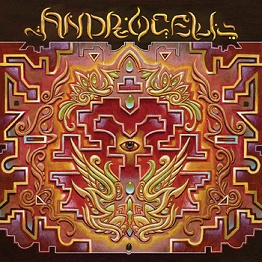
Androcell’s music in general? TS: Thank you ALL for your continued support!! Much love! :) More info about how to get the new album on CD or DIGITAL DOWNLOAD below. If you like the cover artwork and want to know more
about the artist who painted it all, please visit Jack Shure’s website for more
info. |