|
Talks with David Helpling and |
|
Talks with David Helpling and |
|
David Helpling
Jon Jenkins
Treasure
|
JJ: I remember, we’d begun work on the False Summit score when the director decided he wanted to do a pretty extensive re-cut of the picture, which meant the scoring was put on hold for a while. By that time David and I had realized we were working pretty well together and decided to take advantage of the break from the film to continue working on music while the ideas were flowing. I think six of the tracks on Treasure came from those early sessions and three of those are pretty much unchanged musically since then. When I was working on Flow, I knew I wanted to bring in a lot of ambient guitar textures but the only problem was that I wasn’t a very good guitar player. I didn’t even own a guitar at the time. So I called on guys like David, and Howard Givens and Jeff Pearce, because I thought they were all creating some of the best and most beautiful guitar based sounds I had ever heard. My second record, Beyond City Light, was recorded after the False Summit sessions, so I knew from day one that David would be much more involved on some of those tracks. AV: Once the inspiration for Treasure solidified what were some of the initial steps that you took so that the two of you were on the same page in regards to where the project should go and what it should look like? DH: There weren’t really any steps to take to be on the same
page because I think Jon and I are always on the same page. We just wanted to release a great record
that was honest and fulfilled our musical desires. My relationship with Jon is pretty awesome.
He is the closest thing that I have to a best friend, yet he is so mysterious –
a man of few words – and we understand each other completely. Our egos are always out of the way, and we
both just want balance and to have a good time creating music for
ourselves. Treasure was created out of
our mutual desire to make music that we are excited about, so there was never a
formal plan until we had to get down to release dates and artwork. JJ: The project told us what it needed and where it should go. We never tried to decide what it should be beforehand. It simply developed and evolved as we worked, and over time it became clear what form it should take. As far at the collaboration being more difficult, I'd have
to say not at all. If anything it was easier. We were constantly
pushing and inspiring each other to new levels. In addition, if one of us
was having a bad day creatively the other would step in and keep the ideas
flowing, or if one of us was really deep in the zone, the other would handle
the engineering and technical duties that can often interrupt the creative flow
when working alone. AV: What are the advantages of working with another musician on a project? What is it that makes these joint efforts more than the sum of their individual parts? DH: Well, we were inspiring each other and the
music was just happening all over the place.
The big thing for me was the whole self-doubt issue. When I write alone I sometimes get into a
less confident mode where I am constantly judging every part as I come up with
it - wondering if it is good enough.
That kind of situation is artistically very unhealthy and usually leads
to dishonest and contrived results. With
the kind of fun, open and totally creative vibe that Jon and I always seem to
create in the studio, the music just happens.
We don’t judge ourselves, we don’t judge each other, we just create, and
if something is not working or not serving the song well we just agree that it
sucks and try something else. Every
single day that I worked with Jon on this record was looked forward to,
remembered and treasured, the most fun I’ve had working on music, ever. The music always reflected that, it was never
a sum of its parts, it was like a third party. Some of the steps that led to
the ultimate core of what the song was truly about were so random and inspired
that it was difficult to remember what sparked the idea in the first place, but
when it happened it was profound. We didn’t have to say anything, we just knew
that this was what we were searching for. AV: Are the two of you physically near one another? If not do you find that working together long distance is a problem at all these days? JJ: We did everything at David's studio, which is a 20 to 30 minute drive from my place. It's a great drive, mostly on two lane roads winding through the coastal hills. Lots of open spaces and nice views, so it's a great way to prepare for a day in the studio. Much better than sitting in traffic on the freeway for an hour, which was my other option. DH: Musically we are like cousins. We both play keyboards, percussion and guitar. My stubborn and defined guitar style often has me creating bold, rhythmic guitar parts, while Jon’s approach to the guitar is more new and discovery based. His textured-based guitar forms are totally magical. We are much closer related in the synthesizer realm. Our chops are almost equal (though he kicks my ass most of the time in this department). We share the same quest in sounds, expression and impact. We are both percussionists and we have merged our boxes of drums, bells and shakers into a pile in the recording booth. I am hung up on Eastern hand drums and bells; I guess that’s what I brought to the project. Jon is keen on groovy, intricate shaker patterns and big Native American drums and he’s all over the place in this record. So we each have our own passions for instruments and techniques but on every track we are both playing together to create a larger part. It was never on purpose, but our contributions to everything on this record are totally equal. We just do what the song is asking for. JJ: The title Treasure was originally David's idea. I liked it right away because it can be noun or verb, it refers to item or action, and thus works on different levels. Treasure can be some special thing that we hold close and cherish, it can refer to an intangible feeling or memory, it can be something that we are seeking, something that we posses, or something that can't be possessed. In every case it is something special that, for whatever reason, is highly valued. It’s a great title because it provides this palette of ideas that will hopefully inspire the listener to find their own meanings and discover their own treasures throughout the course of the album. DH: That’s a tough one.
I’ve been fighting the term New Age since the very beginning,
straight-up Ambient implies that it’s space music, Cinematic implies that we
are trying to sound like an orchestra and Electronic implies that we are making
the music with a computer. The truth is
that we are doing all of those things.
Labeling music is tough and I still have no answer as to our exact
genre. What do you think we are,
Michael? AV: You know David I have always been of the same opinion as both of you. I don't like to classify music by genre because it tends to be limiting in the sense that you have certain expectations just by hearing the name of the genre and if you judge the music simply by that written heading you might miss out on some great music that breaks the mold. I have different types of music that I like for different things (slow, spacey, tribal etc.) and even blendings of these genres and to me it is either "good music" that I want to listen to over and over again or it is not good music regardless of genre that may or may not ever grace my CD player again. From my initial listenings Treasure is definitely in the category of "good music" and deserves many listens to get a good feel for the project as a whole. It does cross genres moving from space to rythmic with a good sense for both of those genres. Add a dash of cinematic sounds and you begin to understand why David is having a hard time classifying the music and why he would not want to slap a single descriptive term on this music. JJ: About six years on and off. Actually more off than on! As David mentioned earlier, we started working on some of the tracks five or six years ago while we were working on the score for False Summit. Some of the tracks like Treasure, The Frozen Channel, and Now More Than Ever, were pretty much completed back then. Then we both got busy with other projects and life in general, so the record got put on the back burner for a few years. In the meantime I finished Beyond City Light and released it in 2005, with David appearing on three of those tracks. Working on those tracks together got us excited about getting back to working on Treasure again, so we started back into it whenever our schedules would allow. We were writing a good amount of material but we were just not able to find the time to put into the project that it deserved. Then, about a year ago, in June of 2006, we were able to dedicate a solid month to the project, and at that point things really started to come into focus. I did a podcast with David as a guest, and we played some of the tracks that were in progress. The response to that podcast was so huge, and the tracks were coming together so well, that we knew we needed start clearing our schedules and commit to getting it done. JJ: So now that we’ve made a short answer long, if you add up
all the time over the past six years, it probably amounts to about a year of
working on the record, and yes I guess that would be pretty typical if we were
just releasing albums and nothing else. AV: I was interested to see that you purchased a new domain name to go along with the release of Treasure called http://www.deepexile.com Any message in the name Deep Exile? DH: Deep Exile is a name that I created many years ago. It is the name of my music publishing company and what I call my studio. I think it was one of the available domains we had in the running and it was the most acceptable. I wanted something less me and more Treasure but Jon thought it was appropriate. You should chime in Jon, we were in “deep exile” for the entire project. JJ: The reason Treasure took six
years from start to finish was mainly because we were both extremely
busy. However, once we got to the point where we felt like we had
something that was going to be a pretty special album, our schedules opened up
a bit and we were able to work around whatever else came up and stay focused on
the project pretty much from November of 2006 through April 2007. It was
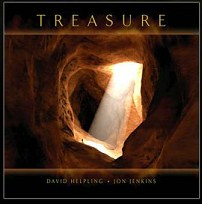
really during that period that most of the work was done. AV: Did the two of you share production duties on the final mixes and how the finished product would sound? If not how did you decide who did what in regards to the technical aspects of this project? DH: The final production and basic balance of instruments and effects happened the same way the music did. We each contributed our desires and just tried our best to get it to sound as it should. Jon did the actual mix and all of the final Equalisation and leveling. He has amazing ears and has really built this skill. He worked really hard the last 3 weeks or so. I would just chime in and say something like “more delay, less bass” or something vague like that. I know I keep saying this but every little decision and tone that he was striving for was pretty much what I wanted. We both like much of the same things in music and sound, I guess. JJ: We went through a lot of different ideas for the cover image. We wanted something stunning and simple, and we had a couple of concepts that we liked, but none of them were really saying, "I'm the one." Then David pulled up this cave image that he had seen somewhere on the internet. We put it up next to all of the other ideas we were working with and it really stood out. It’s iconic, epic in scale, and it speaks to the music. Basically, the image says "Treasure", it's perfect. JJ: It’s different with every track. In some cases the clock decides when a track is as good as it’s going to get. Once you are committed to a specific release date, there are certain deadlines that have to be met. When you hit that deadline, the track is as good as it’s going to get, regardless of what else you’d like to do to it! On a very rare occasion a track will be finished immediately. Beyond Words was the last track we wrote, and it happened instantly. I think the total time spent on that track from the blank screen to the final mix that you hear on the CD was probably one hour, for sure less than two. But that’s the exception, not the rule! JJ: Initially I was exhausted coming off of the final mixes and wrapping the artwork. It was four very intense and focused months putting everything we had into the project everyday, and we took it right down to the wire. Now that I've had a few weeks to sit back, resume a somewhat normal life and hold the finished product in my hands, I'm really very eager to get it out into the world for any and all who will listen. I think we have achieved something very special with Treasure. I'm quite proud of it.
DH: I don’t know. We are both pumped to perform many of the tracks. A couple of them really make us want to play live. We were listening to the masters and certain tracks got us going to do something. To perform this stuff in a way that serves the music would be logistically tenuous, but totally awesome to do. I would answer yes, but I don’t know when or how. DH: I would like to hear Jon answer this one but I feel that this album is like an awesome first date and he’s got my number. We have talked, and there are plans for the next project, but it’s time to get Treasure out there see it find its place. AV: Thanks to both of you for taking the time out to talk to me and I hope that Treasure is the first of many great collaborations between the two of you. |