|
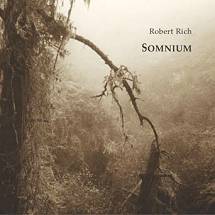
Somnium DVD by Robert Rich |

|
Somnium DVD by Robert Rich |
|
Robert Rich To visit Robert's Site click here.
Somnium (DVD)
Sleep Related Links The Association for the Study of Dreams Standford University Center of Excellence For the Diagnosis and Treatment of Sleep Disorders The American Board of Sleep Medicine
|
AV: Where did your interest in the realm of sleep and music originate? Was this a personal interest or were there some studies involved that moved you along this path? RR: The two interests grew concurrently from an interest in altered states of consciousness, the potentials for the mind to journey beyond traditional realms of thinking. I was still a teenager when these interests began to coalesce, and I had not had the opportunity to explore some of the chemical routes to these states. That's a good thing, since I started to realize early on that nobody needs drugs to journey inward. The tools are built into our consciousness. I was already playing music when I entered college, and I played my first sleep concert in my freshman dormitory, before I decided to study psychology. Later, when I began to focus on sleep research, everything fell together nicely. It all came from a common interest in trance and altered states. AV: At what point did you connect the ideas of a group sleep experience and musical accompaniment that would facilitate certain frames of mind during this experience? RR: As I learned about Indonesian music in my teens, I discovered that the Wayang puppet plays lasted all night long in Javanese villages. I pondered what state of mind the listeners would be in after hours of this music. Later - around 1981, on the radio, I heard an all-night performance by John Cage and Marianne Amacher called Empty Words. They took long breaks every two hours or so, and the audience was awake, but the same ideas re-occurred to me about long durations and trance. Likewise, I read about the long concerts by Terry Riley in the Sixties, and I read about some Fluxus performances (by Richard Hayman I think) where the composer fell asleep with oscillators hooked up to his brain waves. It struck me that it would make much more sense for the audience to sleep, with music that suited the particularly nonlinear ways of thinking that occur during sleep. AV: What kinds of sounds and music did you collect to create a conducive environment for your sleep concerts? RR: I was very interested in the idea of relocating environmental sounds. Bill Fontana was a big influence in that idea, also the book by R. Murray Schaeffer called Soundscapes. I went around the hills near my home recording rain, frogs, creeks, crickets and other continuous sounds. I blended those with drones from the limited electronic resources that I had at the time. It was extremely slow music in those early days, even less active than Somnium. I tried to spread these sounds around the room where people slept, to create the aural illusion of sleeping outdoors, in a constantly shifting virtual environment. AV: Tell me about your first sleep concert and the results that you achieved both expected and unexpected. RR: My very first sleep concert took place in my freshman dorm at Stanford, in February 1982. I advertised with flyers around campus, and on a few local college radio stations. Admission was free. About 25 people showed up, maybe 6 of them from the dorm. The others were mostly strangers - a pleasant surprise. My best friend Rick Davies showed up, and took a few pictures (Rick is the other half of Amoeba.) I began the concert around 11 PM with a 30 minute piano improvisation, and dipped down until only some very quite sounds filled the room. I tried to create a different mood every 90 minutes or so, to correlate with the REM cycle. As far as results go, it's hard to determine. I don't think people really knew what to make of it. I didn't know what to ask them. It felt new, weird, hard to describe. As time went on, and I performed more of these, I came to realize that I was playing more to hypnogogic states (when people are slipping in and out of sleep) rather than to REM sleep and dreaming. However, I did hear some amazing reports of intense and beautiful dreams, which the music had clearly inspired. AV: How many sleep concerts have you done over the years and has there been a progression in what attendees have experienced due to things that you learned from doing previous concerts? What have you personally learned from creating the music and performing these concerts? RR: Perhaps I have performed around 30 or 40 sleep concerts over the last 19 years, mostly between 1982-85, and 1995-96. Regarding my own learning, I think I have realized that I can't pull all-nighters as well as I used to! Truly, the biggest problem I have faced personally with these events is the extreme exhaustion that sets in afterwards. In fact I stopped playing sleep concerts in the mid-eighties because I came down with a mild case of mononucleosis, which prevented me from staying awake for such marathon durations. I learned my lesson 10 years later, when I drove around the country performing dozens of these things on radio stations. It totally wiped me out. On the positive side, I have vivid memories of moments frozen in time, an atmosphere so thick you could swim in it, a room full of people listening to sound with a newfound sensitivity. My favorite memory comes from a concert in Berkeley in the mid-eighties. In the morning, people were starting to head home, while some were milling around the room quietly as I was starting to tear down my equipment. A woman returned to the room after having attempted to leave. She said, "I went outside to go to my car, but everything felt so loud I had to come back in. The music made me too sensitive to the outside noise." I considered this a success, to sensitize a listener to the world around her. When we see our man-made world clearly for the first time, it often seems cold and angular compared to the natural world. Likewise, when we hear it clearly, we realize how harsh and loud our modern world has become. Perhaps, if we can learn to see more clearly the world that we have created for ourselves, we will strive to make it more suitable for our actual existence. If there is anything that this sort of quiet, slow music can provide besides mere sanctuary, perhaps it can invite us to pay closer attention to the world around us, just a little bit. AV: When was it that you first had the idea of putting one of these sleep concerts on disc? RR: I wanted to capture the mood of these concerts on my very first album, "Sunyata", but at the time one couldn't fit more than 30 minutes on a side of vinyl. So, instead I released the album on cassette so I could fit a single 45 minute piece on one side, but it still felt like a compromise. When I started doing sleep concerts again in 1995, I pondered making a 5 CD set that could fit in a standard CD changer, but it still wouldn't be long enough, and the sound of the changer would interfere. I began reading about DVD sometime around 1998, and the concept clicked: at last I could fit an entire night's audio on one disk. I was basically waiting for the technology to make it possible. It took me another few years to work out all the technical details and record the music. AV: DVD's look very similar to CD's but when you set out to put music onto a DVD you find there are quite a few variables that you don't have to contend with when creating a CD. After you had chosen the music that you wished to use on the DVD what kinds of problems and considerations did you run into trying to get the music there in one piece? What kinds of compromises did you have to make between maintaining musical integrity and being able to use the entire selection as you had envisioned it? RR: First off, I ran into a bunch of software limitations in ProTools, based on various file size restrictions imposed by both Mac and Windows operating systems. It turned out that the DVD itself has a similar restriction: nobody could handle a single file larger than 2 Gigabytes. I had assembled the entire composition as a series of crossfades in Protools, and I delivered the whole session on a 9 Gig hard disk to the authoring house, since no single tape nor disk medium would allow me to bounce these crossfades onto a continuous format. Then I ran into a new surprise: even though DVD supposedly holds 4.7 Gigabytes of data, various requirements limited the content size to about 4.3 Gig. Bottom line, I had to make a bunch of compromises to fit the audio onto the disk. The last thing I wanted to back down on was the audio quality, so I gave up a few "little" things like the ability to fast-forward through a section. I figured that people probably wouldn't be listening to it that actively. For me, quality comes before convenience. AV: Being quite different from a group sleep environment, how do you envision Somnium being used at home by individuals? Will this produce similar results or will it open a whole new area of experimentation with your sleep concerts concepts? RR: It becomes a totally different beast, for the simple reason that listening to a recording is often a private experience. I tried to create Somnium with an ear toward multiple listening experiences, expecting that people might also listen to it during the day, while they work, at night with an intimate partner, anything. I can't predict the volume or the time of day that people will play the music. I give up control, and hope the music finds a useful role in people's life. The group sleep concert experience will always differentiate itself by the intense mood created from a group of strangers sharing their personal space together. In concert, the group experience shapes the musical environment. At home, it can take any shape. AV: Did you have any criteria for choosing the sounds and the music that you used on Somnium when creating your soundscapes or were they a random generation by you at the time? RR: Not random, but not intellectually calculated either. I tried to pursue the paths that worked for the multiple possibilities that Somnium would provide for various listening environments. Basically, I just used myself as a barometer of what works and what doesn't. I culled from material that I had prepared for past sleep concerts, and reworked some of the parts that worked best, then I added hours of new material to increase the density and potential interpretations within the sound. AV: Why did you choose not to use a "live" recording for the basis of Somnium but instead create a completely new recording from a variety of original sources? RR: A studio recording is simply different from a live event. The most important thing about the live events is the acoustics and the human energy within the room, and that doesn't always translate well to a recording. I never recorded my own sleep concerts, but I do know about a few bootlegs of radio performances, usually dubbed to VHS-Hi-Fi or something. Those simply wouldn't be adequate. None of the recordings of live sleep concerts had the audio fidelity that I seek when I record a new album. I like to polish my studio work, and make it worthy of multiple listening. I wanted to create something that sounded lush and fresh. That required time to build a new soundscape from the ground up. AV: Do you see the length of the recording or the fact that it was released on DVD as problems when it comes to marketing the project to your listeners? What kind of early feedback have you gotten on Somnium since its release? RR: I care much less about marketing than I do about the pure experience. I don't know if the length of Somnium is a help or a hindrance. Maybe the length will be the one thing that sets Somnium apart and makes people take notice. Only then might people discover that duration alone does not justify this recording. A qualitative shift occurs when people can immerse themselves into a soundworld for such a long time. I want people to experience that shift, it's such a beautiful thing, and DVD was my only choice for realizing this dream. I know that not everybody owns a DVD player; however, increasing numbers of people do have home theatre systems now, and that's one reason I chose to avoid the new DVD-A format and stick with the more established video format. In any case, I didn't have much choice but to use DVD. I waited for 20 years for a medium to surface that could carry such a long duration, and this is the best thing we've got for the present. It just felt like the right time. So far the response has been terrific.
Robert Rich |