|
Reviews 05-22-2004 |
Music Reviews |
|
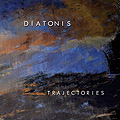
Trajectories by Diatonis
|
Trajectories by Diatonis is a beautiful study in guitar based ambience, conjuring up imagery of rebirth and renewal that are both soothing and inspired. The disc opens with the track "Mourning Sky", a slowly building piece of light pads and minimal guitar work. A harmonic melody weaves throughout, giving the song a sense of depth and darkness, a feeling of profound loss, of endings. Where the first piece suggests loss, track two "Flatland" brings to mind feelings of rebirth in a new environment. Oblique motion is created by the intertwining of rich pads instilling "Flatland" with a sense of renewal and secrets shared. Sublime. Track four, "Cloudless", follows the same theme of a new environment with a sense of a sky so blue, so clear, that words haven't been invented yet to describe it's beauty. Soft drones in the background of the piece suggest a lazy heat giving way to cool night air. Beautiful. "Nothing in Mind" sees a return of simple guitar over slowly rising drones, suggesting the birth of identity, of self. There's something very life affirming about this track, something very inspired, powerful in it's depth. Closing track "One to Be" features minimal melodic work throughout, a slight sense of closure to the experience, paired with a feeling of having come full circle to the point where it all starts again, a point from which lessons will be relearned and experiences will be had for the first time again. A charming piece to close the disc. A lovely body of work, "Trajectories" is a collection of songs that celebrates the magic of life and revels in the joy of discovery. Diatonis has created a truly wonderful disc with this release, a work sure to remind us of the beauty that surrounds us. Reviewed by Rik Maclean of Ping Things reprinted here on Ambient Visions. Visit Rik's Ping Things website by clicking here. |

|
World of Shadows by Various Artists Visit Deep Listenings' website
|
Gianluigi Gasparetti, recording as Oöphoi, is no stranger to
the self-released CDR. While many of his
most memorable ambient works have appeared on labels like Amplexus and
Electroshock, the vast majority of his work has appeared on very limited,
self-created, CDR. It stands to reason,
then, that Gasparetti's next step was to start his own label of home-made CDR
releases. Umbra records
might have threatened to be an outlet for only
Oöphoi-related projects--as it turns out, it will also be the first opportunity
for ambient fans to hear new and obscure artists from overseas. The first Umbra release, World of
Shadows, is, appropriately, a multi-artist compilation outlining the
future direction of the label, and serves as an interesting taster of artists
both familiar and unfamiliar. First up is Sostrah Tinnitus's track "Corifeo delle Rane"--a vaporous zone of gusty ambient, with clacking sounds resembling the processed ticking of clocks. Synth washes rise and fall amidst the clattering bone sounds of various objects. The feeling here is of a less organic Alio Die, though the sounds change more progressively over the track's relatively short length. What seems like organized chaos at first turns out to be rather orderly in the end, with a wall-of-sound climax followed by a dramatic, classical coda. Having heard Sostrah Tinnitus's two albums (one on Umbra, the other on Beyond Productions), I can say that this is not the most exemplary track by the artist, but functions well as a teaser for those superior albums. Next is the impressive "Nocte Sublustri" by newcomer Netherworld. Dark, isolationist ambience in the vein of Thomas Köner can be found here, right down to the otherworldly bass thumps. A thick drone with various bleak synth-impressions ebbs along; a vision of the blackest kind of space. Distant scrapings of metal or stone, highly reverbed, are heard--perhaps the hidden movement of planets, tectonic plates, the mandibles of a giant insect. An auspicious debut for this artist; his first album Hermetic Thoughts perhaps one to look out for. Next is frequent Oöphoi collaborator Tau Ceti, and his track "Sator Arepo." Shades of Celestial Geometries here, with a harrowing, slow synth line low in the mix. The more eerie portions of Michael Stearns's Encounter make for a strange excursion into deep space. The track meanders, bassy vibrations breaking up the claustrophobic blackness from time to time--similar to Lustmord, but without the grand guignol theatrics. A fine track, even if a little standard. Klaus Wiese and Oöphoi give us "Hieros Gamos" next, featuring Wiese's instantly recognizable Tibetan singing-bowl atmospheres. These drones are combined with creepy whispering straight out of Oöphoi's Night Currents and extremely potent synth textures that glide through the speakers. Headphone listening is recommended. A reverent, mystical atmosphere is created--perfect for the deepest night listening when the world is still, aside from the drifting tones of the music. Another new artist, Perceptual Defense, is next with "The Last Tear." This track is similar to Tau Ceti in mood--a synth-created atmosphere of intense blackness, with only strange waveform sounds lancing across the skies. The terrain here is bleak, melancholy; VidnaObmana-style synthclouds pervasive along with the deep space droning. This track is good, though fairly one-dimensional over its length. Finally, Oöphoi closes the album with the
twenty-three minute "Substance Metallique." Similar in feel to his recent set of EPs,
Dreams, "Substance" is extremely quiet, almost at
the edge of audible. It is as if one is
looking out from a pier at a vast ocean, stretching into seemingly infinite
distance. Occasionally one notices vague
movement, unusual sounds echoing across the water. The most action is, however, beneath the
surface, hidden from view. Perhaps not
the strongest Oöphoi track, often due to the extreme quiet
of the track--it wisps in and out of the listener's consciousness a little too
readily, too ambient for its own good.
Bleak and mysterious, but ultimately hollow. World of Shadows various tracks
certainly suit the bleak title, while showcasing the interesting artists of
Umbra records. The album lacks diversity
due to the narrow focus of all the artists on bleak, deep ambience, but is also
of extremely high quality. Perhaps, when
taken as a total, World of Shadows can seem as too much of a
good thing--each track melding with the next until one can no longer discern
just who one listening to.
The quiet nature of these tracks, perhaps from the mastering process,
forces the listener to increase the volume in order to hear what's going
on. Headphone listening is not only
recommended, but almost necessary to appreciate what’s going on in each track. Even at higher volumes, some of these tracks
(most specifically the final Oöphoi track) seem too ethereal for their own
good--it's simply too easy to drift off and lose track of what one is listening
to. Nevertheless, World of
Shadows is a worthy sampler of Umbra's label focus. Ambient fans who prefer a little more sonic
"meat" to their recordings would do well to steer clear. Those who can't get enough of ambiguous,
shrouded, soundscaping will likely already have this album, limited to ninety-nine
copies, in their collections. Reviewed by Brian Bieniowski reprinted here on Ambient Visions. |
|
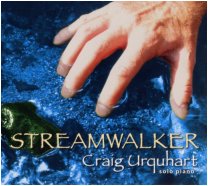
Streamwalker by Craig Urquhart Visit Craig Urquhart's website
|
Streamwalker is a beautiful collection of original piano solos by Craig Urquhart that range from gently melodic to more abstract and ambient to jazz. A classically-trained pianist who worked as Leonard Bernstein's personal assistant for the last five years of the legendary composer/conductor's life, Urquhart's music sounds deceptively simple. However the complex harmonies and rhythms as well as Urquhart's emotional and nuanced playing style allow the listener to discover new facets with each listen. Urquhart leaves a lot of open spaces between the notes and phrases, preferring subtlety and expression over showy pianistics, making this CD a very satisfying experience on a variety of levels. All of the tracks on Streamwalker has its own charm,
but I do have some favorites. The CD opens with Morning Eagle, a sublimely peaceful piece that was inspired
by watching eagles flying overhead while on a canoe trip. It is easy to picture
these powerful birds effortlessly gliding through the skies, riding the wind
currents. The Astronomer is a quietly passionate piece reflecting the awe of
losing oneself while looking at the vastness of the night sky. The open feeling
of this piece and the deeply emotional expression make this a real standout.
The Awakening is a piece Urquhart composed as a birthday gift for Leonard
Bernstein, and is a bit more classical. Urquhart usually includes one bluesy or
jazzy piece on his albums, and Jazzed is that selection on this album.
Showing a different side of his playing and composing, these pieces tend to be
a bit whimsical and fun, lightening the mood considerably. Interlude is
several shades darker and more reflective - gently melodic and very evocative.
Reverie is a special favorite, depicting the entrance to the world of
dreamtime, the magical state where all living things are connected in peace;
this is serenity set to music. Urquhart wrote the haunting Ghost Canyon just
days after 9/11, observing the empty urban canyons of lower Streamwalker is currently available from
www.craigurquhart.com and www.cdbaby.com. Very highly recommended! This Kathy Parsons review originally reviewed for Solo Piano Publications website. It is reprinted here on Ambient Visions with permission. |
|
Borrowed Time by Lammergeyer VisitDatabloem Records' website
|
A new project by Anthony Paul Kerby of The Circular Ruins, Lammergeyer has created a highly emotional body of work using a combination of electronic and more organic sounds. The third in a series of releases in a similar vein, Lammergeyer's Borrowed Time is a study in beautiful and lush tones. Opening with "Prolegomena", a mournful melody slowly builds accompanied by light percussion and keyboard work. Constantly moving, shifting, tones change shape and respond to eachother in an almost organic manner. Beautiful. Skip ahead to track four, "Point of Intersection" where the sound of keyboards echo the sounds of a sparse rain, minimal drones and metalic tones sliding across one another. With "Echoes" the sound of oscillating drones like radar waves bounce back and forth through the ether. A low hum slowly rises and falls throughout anchoring the piece, while minimal keyboard work adds a sense of wonder. "Anything can be Everything" pairs steam like tones with starbright chimes in an unlikely blend that works very effectively together. Gaining a certain mechanical quality to it, the song is slowly overtaken by a series of metallic hits that create an impressive tension. "That Suddenly Are Real" features a pumping squelchy bassline that wraps around itself, entwining other more subtle melodies in a tight grip. Sound fades in and out with a seeming randomness thad adds colour and depth making it all the more striking in it's beauty. What a beautiful track! With each listen to Borrowed Time I find new sounds, new melodies, and new themes to discover. All of the songs here are treasures to be discovered again and again. Borrowed Time is truly a fabulous release who's effects have stayed with me long after the last tones have faded away. Reviewed by Rik Maclean of Ping Things reprinted here on Ambient Visions. Visit Rik's Ping Things website by clicking here. |
|
Tibetan Temple Bells by Acama
|
There could very easily be a tendency or inclination to
dismiss CD”S of Tibetan Singing Bowls as all being the same. To a large degree,
they are all very similar. The instrument does not allow for great flexibility.
Each disc, however, has its own charm and usually reflects the spirit of the
performer. Tibetan This is a beautiful and essential adventure. Reviewed by Jim Brenholts for Ambient Visions. |
|
Fever Dreams by Steve Roach
|
Steve Roach is an artist who creates an environment for his listeners, self-contained worlds that exist entirely within the confines of his music. With his latest, Fever Dreams, Roach has made a disc filled with beautiful and mystical places, a hyper reality akin to the most intense of reveries. A collection of four long form pieces, Fever Dreams brings to mind the desert that has inspired so much of Roach's work, filled with a ritual and mysticism that speaks to our souls. "Wicked Dream" opens the album with shakers and light percussion conjuring images of vast spaces, wide open terrains made bright in the hot sun of high noon. Deep bass drones pass through the soundscape like clouds moving across a clear blue sky made hazy by desert heat. Additional textures drift pass, landmarks along the horizon. A sense of something mysterious and otherworldy. In contrast "Fever Pulse" brings to mind a night time ritual, surging forward with rolling percussion and drifting pads flying by like spirits awakened by unheard voices. Metallic tones rise and fall in irregular intervals interspersed with spiralling sounds that recall the twinkling of stars. A sense of ceremony, of shared communal magic. You can't help but feel the pulse in this piece. Track three, "Tantra Mantra" starts subtly with fluid tones and minimal beats, slowly gaining in voice, climbing in strength. Hand percussion gives way to deeper, more bass driven drumming, hypnotizing, primal. Subtle variation drifts through it's nearly thirty minute length, enrapturing the listener in a swirling spiral. Beautiful. "Moved Beyond" closes the disc with powerful percussion, hypnotic pads ascending and descending. The sounds of wind through chasms, canyons, the moon passing through the night sky marking the passing of midnight and beyond. And slowly, like the dreams of the disc's title, the intensity lessens until all that's left is a vivid memory of a journey to strange lands. "Fever Dream" is quite simply an astounding piece of music, an excursion to beautiful soundworlds, to exciting new vistas. Steve Roach is an artist who creates an environment for his listeners, and with this release he has made one of his most beguiling and enticing environments yet. Highly recommended. Reviewed by Rik Maclean of Ping Things reprinted here on Ambient Visions. Visit Rik's Ping Things website by clicking here. |
|
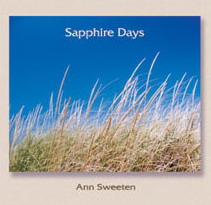
Saphire Days by Ann Sweeten
|
Ann Sweeten's Sapphire Days is quite simply one of the most graceful and quietly soothing albums I've heard. Soothing often implies ear candy, but that is definitely not the case here. A classically-trained pianist, Sweeten's themes of nature and saving the environment and animals come from the heart, expressed gently but fervently. The pieces sound deceptively simple, but each is a perfect little gem. The pace and overall feeling of the album is consistent enough to sustain a mood or meditation, but treat yourself to listening to this music carefully and then let it carry you away to a peaceful, tranquil place - a sapphire day! All thirteen tracks are original, played on a Steinway grand piano, and Sweeten adds some synth washes for color and ambiance which are never obtrusive or distracting. I really like this whole album, but a few of the pieces are exceptional. Walking With the Wind opens the CD with a wistful, dreamy piece that is both leisurely and passionate. The title song is optimistic and graceful with an absolutely gorgeous melody. Smoke is a little moodier, and describes wispy swirls of smoke as they rise and float away as well as the surges of smokey billows - very effective! In the Shadows is also a bit darker than the other songs, but is so evocative - this is my favorite of the collection. It is very introspective and bittersweet - I love it! Sapphire Days is Ann Sweeten's fifth album to date, but it is the first that I have heard. I'm really looking forward to getting better acquainted with this artist! Sapphire Days is available from www.annsweeten.com, www.amazon.com, and www.cdbaby.com as well as various retail outlets. Very highly recommended! This Kathy Parsons review originally reviewed for Solo Piano Publications website. It is reprinted here on Ambient Visions with permission. |
|
Laivoja ja Junia by HEI
|
I'm going to go out on a limb and say, before I even begin
my review, that Hei's Laivoja ja Junia is the best ambient
album you've never heard for 2004.
Readers of my lovelorn missives about ambient music know that I don't
level such praise lightly. A little
backstory: After a particularly lousy
day at work, I came home to find a battered package from Though there is precious little information available on the
internet, Laivoja ja Junia (English translation: "Ships
and Trains") appears to be a meditation on travel and distance. While the travel content of the album may be
ambiguous, the feeling of distance is evident from the first track, "...Me
Encontré Solo en la Oscuridad" ("...I Was Alone in the
Dark"). A flamenco guitar, sounding
as if it is played on an old phonograph located deep within a tunnel or cavern,
crackles dark and distantly. A sonorous
tenor joins, deep and electronically tampered--his voice breaking up periodically,
as if played through blown speakers. A
bizarre but compelling start--we're in for quite a ride. "Junia ja Laivoja Akureyriin" is
next, beginning with a furiously-layered classical guitar, as if Ennio
Morricone and Steve Reich collaborated on a soundtrack to some lysergic
spaghetti western. This impassioned
spiralling of guitar playing devolves into pure ambient wall-of-sound, phasing
wildly throughout. It quiets at around
the nine-minute mark; a silence permeated with sitar-like plucking, a strange
ethnicity unknown and untraceable. Even
this is deconstructed by track's end into a Stars of the Lid dronescape,
eventually evaporating entirely. A
staggeringly fine beginning. Next,
"Pohjoisnapa/Der es Salaam," offers a brief Spanish guitar strum,
echoed as if played within the Cistern Chapel of Deep Listening Band fame. This is something of a palate-cleanser, as we
are next treated to the most difficult track on the album,
"Tango." A bizarre melodica
melody brings us into the French cafe of the psyche. Pauline Oliveros is here to shock you out of
your coffee-colored reverie; this quickly becomes a melodica-drone track with
some intriguingly difficult sonorities.
Perhaps less successful than the rest of the album due to its
aimlessness, "Tango" serves as an unusual confection in a record full
of sonic delights. "Lumisade"
inhabits Lull or Lustmord territory, with subterranian drones accompanied by
lovely guitar washes. The crackling of a
vinyl record, or perhaps rainfall, gives this track a desperate melancholy,
aching to behold. Yet another highlight,
and one of the strongest tracks on the album.
"Punainen Harmaa" is next, a drifting dronescape of subtly
shifting tones, many of them high-pitched and slightly piercing. The guitar harmonics gel marvelously here,
offering dark ambient fans an isolationist treat. If I had to assign track lengths on the
album, I'd probably switch this with its predecessor "Lumisade," as
"Punainen Harmaa" seems to meander on a bit too long for its nearly
thirteen minutes. Finally, "Laulu
Kuulle, ja Sateelle," presents another rain-soaked, melancholy atmosphere,
perhaps drawn from the melodica. A
subtle connection to Aloof Proof here, as a traditional instrument is bent to
the infinite will of ambient--yet another resonant, subtly shifting
tonescape. This is particularly lovely,
as the different tones frequently form accidental melodies. This track is somehow
ethic in flavor, with environmental noises offering
comforting textures, as if a lone melodica-player intones along with the
gradual action of the world around. Be
careful with this track--sleep is not recommended; there's a surprise at the
end of the track I'll leave for the curious listener to discover. Hei creates a marvelously diverse and layered effort on
Laivoja ja Junia--one that surprised me as often as it
delighted. Hei seems particularly
indebted to the early minimalists--on this album it's as if modern electronics
were deserted entirely to give the album a timeless, classic feel that is at
once familiar and original. Traditional
instruments are chosen over the latest in technology, making a simple, lovely
statement that's all over the ambient map.
While you'll find no "original" sounds here, per se, Hei is
clearly a practiced musician that delivers a fine record, satisfying all the
way through. Fans of darker zones of
ambient are encouraged to explore this work--I can't imagine appreciators of
Mick Harris's ambient work, Lustmord, Caul, and others, finding a better album
in 2004. I'm going to cut to the chase
here: Head over to White Noise's site
and listen. The label accepts
Paypal--treat yourself. You'll be glad
you did. Laivoja ja
Junia gets my highest recommendation. Reviewed by Brian Bieniowski reprinted here on Ambient Visions. |